Three Stories That Remind Us Why We Teach

By the time winter break arrives, many educators aren’t just tired, but they’re carrying things. Heavy decisions. Hard conversations. Students we can’t stop worrying about, colleagues we want to reach but don’t quite know how.

This season invites rest, but it also invites remembering.

Stories matter because they reconnect us to purpose without pretending the work is easy. They remind us that meaning is often found not in the outcomes we measure, but in the people we continue to show up for. Here are three stories that continue to remind me why teaching and leading in schools still matter deeply, even in the hardest seasons.

Story One: “Every Kid Needs a Champion”

Years ago, I watched Rita Pierson deliver her now-iconic TED Talk, Every Kid Needs a Champion. I’ve revisited it many times since, and it still tugs at my heart.

Her message wasn’t about instructional strategies or school improvement plans. It was about belief. About adults choosing to stand in the gap for students, even when those students push back, shut down, or test every boundary. Her talk reminded me of a student I met in his freshman year of high school.

About twenty-three years ago, a young man stopped by my office and was pretty distraught. I was his ninth-grade Global Studies teacher, and then I became his assistant principal. I had a strong relationship with him and his family. His mom also called me to let me know he might stop by because “things are pretty bad.” So, I wasn’t surprised by his visit, but I was surprised by what he shared.

He was done: done with school, done with home, done with everything. We talked for about half an hour, and he seemed to feel better, but when he left my office, he didn’t return to class; he left the building…

I called his mom to let her know how our conversation went, and she told me she’d let me know if he shows up. A few minutes later, she called to let me know he was home.

Thankfully, he returned to school the next day and finished the year. Before summer break, he gave me a handwritten note thanking me for taking the time to listen. In that note, he shared that he had considered harming himself and that our conversation helped him see things just a little differently.

Stories like this remind me that we may never fully understand the impact of a single conversation, but students remember who showed up when it mattered most.

Years later, on April 6, 2024, I ran into his parents at Home Depot. They shared incredible news: their son was thriving and nearly finished with his doctoral studies. We shared a long hug and a few tears!

Story Two: The Student Who Didn’t Give Up

A couple of years ago, I watched a student in one of our Career-Technical Education programs struggle academically, behaviorally, and emotionally. The CTE lab instructor tried everything to help this young man: tough love, coaching, peer mentoring, parental involvement, you name it. To say he was frustrated with this student is an understatement.

However, instead of labeling the student, he chose persistence.

He didn’t lower expectations; he increased support. He created notecards to help him learn parts. He asked the student to come to the lab during study hall for additional help. He allowed a couple of test retakes after some further review sessions, and he partnered with an Intervention Specialist to learn about other accommodations.

The young man drove a beater of a car that needed a lot of work. The instructor helped him fix his car, which reinforced the skills he was trying to teach him, and he helped him land a job in his chosen industry. Months later, he graduated from his school and earned an industry credential, which helped him get a promotion.

What stood out most wasn’t just the outcome, but the educator’s refusal to separate skill-building from dignity.

Story Three: Choosing Connection When Convenience Would Be Easier

This story isn’t about students, it’s about adults.

One of my executive team leaders consistently chooses conversation over avoidance, growth over comfort, and trust over tension. Whether addressing curriculum concerns, procedural challenges, or personnel issues, her approach is steady: listen to learn, seek the back story, and collaborate toward solutions.

When she first arrived in our district, she heard many negative comments about our application process, which was pretty new. Since it fell under her supervision, she met with those who had concerns, met with members of our Business Advisory Council, and gathered feedback from our building leaders. After months of information gathering, we created a new application process that was much more widely accepted and, most importantly, better for students.

Because of her approach, difficult conversations that could have fractured trust instead became opportunities for alignment and growth.

As you head into break, give yourself permission to rest. Disconnect where you can. Refill what the semester has drained. When you return, recommit to one student or one colleague you’ve been struggling to reach.

Rest now. Then carry one name with you, and begin again.

Wishing you and your family a Merry Christmas, Happy Holidays, and a Happy New Year.

Be Great,

Dwight
Motivating The Unmotivated

One of the hardest challenges we face as educators is working with someone who isn’t motivated. I bet someone popped into your mind the moment you read the title of this post.

What makes motivating an unmotivated person so challenging? During our professional learning day last week, I heard, read it in the virtual chat, and talked to a few people about this topic, and it’s a significant point of frustration. I know many of you can relate to this. So, I’ve been thinking about this quite a bit as I am experiencing an unmotivated child at home. Well, she’s intrinsically motivated when she’s interested!

Let’s start with how we define motivation: the general desire or willingness of someone to do something. So, if motivation is about one’s will, how do we help ignite that spark without forcing it? The truth is we can’t motivate someone, but we can create the right conditions to inspire it. We can coax, threaten, bribe, beg, or lecture, but these strategies may breed short-lived results. My wife and I continue to try new things and have found that we have to keep the ideas fresh by making connections between my daughter’s interests (at the time) and the homework or other tasks she needs to complete. What makes this even more challenging is that, like many of you, my wife and I are intrinsically motivated—and always have been—so it’s hard to understand why others aren’t. This lack of understanding can lead to judgment, frustration, and apathy.

If you are in the same boat, Here are a few practical strategies that have worked for my family and may be helpful in your classroom:

Set Clear Goals– Set clear, attainable goals so they can experience success. However, it’s important to note that setting these goals can be a challenge, as they need to be both challenging and achievable. Maintain high expectations but break them into manageable steps to help students experience success.

Give Responsibilities– Making students responsible for tasks that help the classroom or lab function better increases the likelihood of them understanding what it feels like to be motivated from within. Be sure the responsibilities aren’t punishments but add value to others, including those responsible. For example, assigning a student to organize materials or lead a warm-up activity can foster a sense of ownership.

Make Learning Relatable– Learn about your students’ interests—what they’re reading, watching, listening to, or doing outside of school—and connect that to the content. For instance, if a student is interested in sports, you can use sports statistics to teach math. If a student is a fan of a particular book series, you can use that series as a basis for a literature lesson. This might require adjusting how you deliver instruction, but the payoff is worth it.

My daughter’s interests change often, so we have to listen carefully during our conversations to learn how to connect them to upcoming tasks. For example, she loves listening to podcasts, which are about 15-20 minutes long. Over the weekend, I set a timer for 20 minutes for her to complete an assignment and gave her a five-minute break. During the break, she challenged me to a game of Speed or Checkers. Once the break was over, she got back to work.

Positive Feedback– My daughter thrives on written and verbal praise. We’ve learned to highlight her effort, especially when she’s learning something new, to help her recognize the feeling of intrinsic motivation. Strive for balance—too much praise can lead to complacency, while excessive criticism can discourage progress.

Collaborative Learning– Learning is social. Providing opportunities for students to work together improves engagement and develops essential employability skills. What better way to strengthen collaboration than through group tasks and projects?

Motivating an unmotivated student isn’t about having the perfect strategy—it’s about trying, reflecting, and adjusting. This week, identify one unmotivated student and apply one strategy consistently for two weeks. Reflect on what works, what doesn’t, and what adjustments you can make. This process of reflection and adjustment is a powerful tool in your hands. Share your experience with a colleague—or better yet, with the whole team.

You don’t have to be an educator to try these strategies. If you, a family member or a colleague need a push, try one yourself, then celebrate the progress!

Be Great,

Dwight

“We Don’t Choose What People Remember”

A couple of years ago, I walked into my office to begin my day, sat down to turn on my computer, and noticed a slither of red illuminated my phone receiver. I briefly shrugged it off, deciding I’d check in a few minutes because I was on an emotional high from an email I received earlier that morning.

The email was from a student I had my first or second year of teaching 8th grade US History (1994-95). He had become an elementary principal in a local school district. Mind you, I last saw or talked to him when he graduated from GLHS. My book had just been published, and unknown to me, he read it and wanted to share his thoughts. It was a glowing review of the book and a couple of stories of things I did or said to him as a student that positively impacted him. His kind words surprised and humbled me because I didn’t remember what he experienced. I was grateful for his kind gesture and felt great coming into the office that day!

Once I turned on my computer and checked my work email, the illuminated phone receiver shined brightly as a reminder to check my voicemail. I picked up the receiver, pressed the voicemail button, tapped my password, and listened to the prompts. I selected the first prompt and heard the following words:


“Hello, Mr. Carter. You may not remember me, but I was one of your students when you were Principal at Lincoln High School. I just wanted to tell you that I hope you aren’t doing to other students what you did to me. You embarrassed me during an expulsion hearing and made me feel so small in front of my mom. Your words hurt me deeply, and because of you, I am pursuing my doctorate in cultural anthropology. I am better than you, smarter than you, and despite what you said, I will always be more educated than you…”

The caller continued to share how my words broke them. My head was spinning as I tried to recall this interaction. With a shaky head, I scribbled the caller’s words on any piece of paper I could find as quickly as possible. I was shaken, embarrassed, and, quite frankly, confused. After a few more colorful and choice words, the caller politely ended the message and hung up…

I sat back in my chair, dazed and defeated, and tried to process the situation. Who was this person? When did this happen? What am I going to do about it? I slowly sat up to look at the incoming number, but it didn’t match the caller’s name. Should I call them? Will I get defensive if we talk? What should I do?

In an instant, the joy I felt from the email was quickly replaced by shame and worry. What popped into my head were the following words of Dr. Joe Sanfelippo, former Superintendent of Fall School School District in Wisconsin,

We don’t get to choose what people remember. Treat every interaction as if it matters because it does.

I took a few more minutes (days) to see if I could recall any experience like that, but my mind was blank. Whether I remembered or not, what mattered most was that the caller remembered it as it happened to them. I appreciate the lesson and reminder to treat everyone with the dignity they inheritedly deserve.

The last few weeks of school can be stressful, so let’s remember Dr. Joe Sanfelippo’s words and create moments that create positive memories for ourselves and others.

Be Great,

Dwight

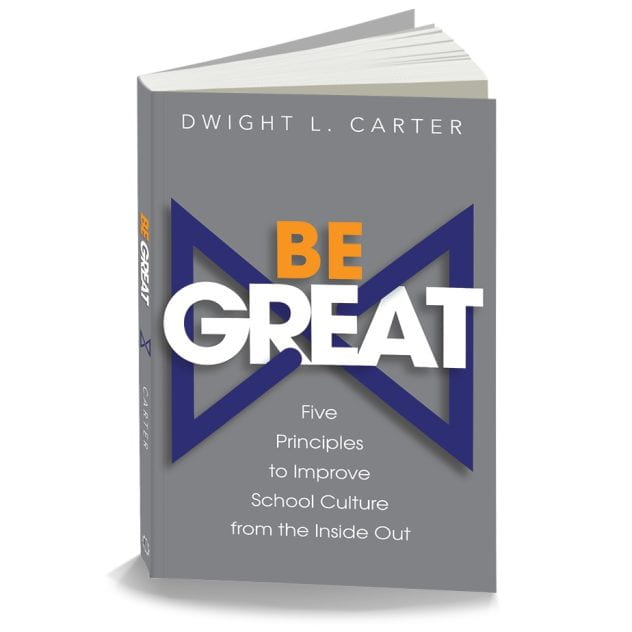
Get your copy of Be GREAT: Five Principles to Improve School Culture From the Inside Out here!

The Trusted Adult

I am the Director of Student Support Systems for the Eastland-Fairfield Career and Technical School District. It’s my second year in this role, and I absolutely love my team, the work, and our focus on the whole child.

We have a laser-like focus on creating the best conditions to engage, enrich, and equip students every day in every experience, and one of the best ways to do that is for each of us to be a trusted adult for at least one student.

via GIPHY

Trusted adults provide psychological safety, so students feel safe, procedures as consistent, and routines and behavior are predictable. When that occurs. students thrive!

In the movie Man of Fire, Creasy (played by Denzel Washington) was a down and suffering officer who lost his purpose in life until he met Pita. Pita was a young girl who lacked confidence and was a bit timid. Together, they formed a bond that allowed Pita to improve her self-esteem, gain confidence, and improve her performance as a swimmer. One of my favorite scenes is Pita’s swim meet. To prepare Pita for the meet, Creasy identified what she needed and used specific strategies to help change what she experienced in the water and life.

Watch the video clip below and focus on what the nun says to Creasy and what you notice about the relationship between Creasy and Pita. We don’t have to be our students’ world to have an impact; we just have to show we care for them, believe in them, and want the best for them.

How will you establish trusting and positive relationships with your students this year? How will you do the same with your colleagues? Better relationships lead to a more profound commitment to the work and more positive outcomes.

I discuss the importance of positive relationships and other guiding principles in my latest book, Be GREAT: Five Principles to Improve School Culture From the Inside Out. Get your copy today!

Be Great,

Dwight

Perspective

The last two years have forced us to think differently about educating students. When we created online and blended learning models in response to the pandemic, we could see what was possible on a much larger scale than piloting a new delivery model in a single classroom or grade level. Some flourished while others floundered. We had to break any thinking trap that prevented us from creating a different education model.

It’s easy to fall into thinking traps about ourselves, our work, and other people. It may take a new experience, perspective, or vision to get out of those traps and change how we see the world around us. However, just like the traditional education model doesn’t work for every student, the change to online or blended learning models doesn’t work for every student either. It’s about providing several options for students and families.

Students, families, and educators are started to demand options because their perspectives have changed from the experiences of the last two years. Some ask why we can’t offer online options for students who want them. Why can’t we provide flexible work schedules for teachers and administrators who wish to offer student scheduling options? Again, perspectives have changed, which has led to discussions about what significant, systemic changes are possible for education.

I work in a Career Technical Education district, and when the pandemic first hit, we, like all schools, created a schedule to cope with the sudden disruption of forced closer. We scrambled to keep learning relevant. Students were used to spending half their day in their Career Tech Labs. We struggled to transition those types of experiences to an online environment. Quite frankly, it was impossible.

When the 2020-2021 school year started, we were committed to getting our students back on campus. We discussed various scheduling options and the logistics to make them a reality. Our perspective focused on allowing students to experience relevant hands-on learning in an environment set up for those experiences. We had to get our students back on campus.

After a few weeks, we brought students back on a hybrid schedule where they came for lab only and completed their academics online. It was not ideal, but we made it work, and our students responded well to it. We were intentional about it and took several iterations to find something that worked for the most part.

Often, this takes some intentionality, but it could happen after a little happy accident (Bob Ross!). Watch the video below to see what happens when an ostrich accidentally trips into a new vision, which ultimately creates new possibilities for the entire flock. As you watch it, I encourage you to think about the following questions:

What new opportunities will you create for yourself and others around you with a bit of change in perspective?

What intentional steps can you take this week to broaden your perspective to meet the changing needs of students and staff?

Be Great,

Dwight

Accessible

https://aitpdf.ca/blog/the-importance-of-an-accessible-pdf-document-strategy/
I had an impromptu meeting yesterday morning that was just what I needed. Around 7:50 am, I received a call from our receptionist to let me know a young man needed to see me. I quickly responded and asked her to send him to my office.

When he entered my office, we greeted each other in our standard and affirming manner, and then he sat down. His reason for coming in was hidden behind a logistical request, which I could discern by his body language and the way he slumped down in the chair in front of me. Through a masked mouth, he asked, “How’s your mental health?” I was shocked by his question but took it as a hook. He wanted to talk about how HE was feeling, so I gladly accepted the bait. I responded to his request by sharing a little bit about my weekend and how I felt at the moment and pivoted to asking about him: “How are you doing? What’s going on?”

He shook and dropped his head while rubbing his forehead with his right hand. He said, “Man, Mr. Carter. I’m struggling…” I turned my chair to make sure I was directly facing him and leaned in to let him know that he has my undivided attention.

He opened up about his life, the real obstacles he’s trying to overcome, and how overwhelmed he’s feeling. The more he talked, the straighter he sat in his chair, and the more animated he became.

He talked about his future goals, and I assured him that we would do whatever it takes to help him get there. We shared a few stories, and I gave him the information he came for. After about 20 minutes, I sent him a class pass, and he went about his day. We were both fulfilled. I took away three reminders from our chance meeting:

Be Accessible– I had a few things I felt that I needed to get done before the first-period bell rang, but it was more important to meet with my student than to tackle my to-do list.

Be Available– I was open to listening to his story and available to provide emotional support and tangible help, at least at the moment. I also let him know I am available to help anytime.

Be Accountable– Earlier in the school year, I noticed this young man seemed to be carrying a heavy burden, so I stopped him in the hall to check on him. He wasn’t in the mood to talk much but assured me he was okay. I let him know that I’d be checking on him from time to time and that he could stop by the office anytime he needed to talk. Well, yesterday he did just that. To be accountable is to deliver on one’s commitment. I made sure I was accessible and available, thus responsible.

We must never lose sight of why we became educators, and for me, it is to positively change lives and impact futures. Be accessible today.

Be Great,

Dwight

Parting Words of Wisdom to New Albany and the Class of 2018

Mr. Sawyers, the Board of Education, parents, staff, and faculty, THANK YOU for embracing my vision to create a school where every student has a sense of belonging, a belief in their abilities, and a desire to grow. Thank you for standing by us as we navigated the waves of change and overcame unforeseen obstacles. Thank you for welcoming and embracing me into this school community!

Graduates, THANK YOU for allowing me to play a small role in the most important years of your lives thus far. Thank you for your perseverance, for using your voice to promote change, and your determination to take advantage of everything New Albany High School has to offer. You will forever be a part of my life!

I have asked a great deal of you the last four years and I cannot let you go without making one more request.

For the next two minutes, pretend you are sitting in your first period class and the 8:00 am bell rings to signal the start of the school day. Imagine hearing the “chime” of the public announcement system and your ears perk up as you await the all-too-familiar greeting you heard for nearly 725 days:

Good morning, New Albany High School Class of 2018. This is Mr. Carter with a few parting Words of Wisdom.

As you embark on a new chapter in life, ask yourself the following questions:
Am I giving or taking?
Sustaining or draining?
Contributing or withholding?
Connecting or conniving?
Uniting or dividing?
Whatever you decide, it’s up to you!
– Jon Gordon

With so much information coming at you each day, “take time to put silence between your conversations. You may even start remembering what you said and discovering what you can learn from others. “ -Melody Beattie

“When things aren’t adding up in your life, start subtracting.” -Anonymous

If you want to change your life, change your daily habits.

“Time is more valuable than money. You can get more money, but you cannot get more time.” So, don’t wish away what is NOW by focusing so much on what’s NEXT. -John Rohn

“You’re less of who you could be when you’re trying to be someone you’re not. Therefore, get to know, accept, and embrace the real you.” -Melody Beattie

In your pursuit of happiness, “be happy not because everything is good, but because you can see the good side of everything.” -David Roads

“Allow yourself to be a beginner. No one starts off being excellent.”
-Simple and Inspired

In a society that is so contentious, remember that “It’s impossible to argue when one person refuses to fight and instead responds only with peace. Be the person that responds with peace.” -Melody Beattie

“Be the person who smiles politely when people look at you. Be the person that says the positive thing when everyone else is complaining. Be the person that gives advice from the heart. Be the person that tips generously. Be that person.” -Anonymous

“Life and the people sent to us– the people we love– are gifts. Love people for who they are. Let yourself be you. Feel whatever you feel. Do the work for the sake of work instead of for the results you hope to get.” -Melody Beattie

“A good boundary to establish for yourself is to talk about a person the same way you talk to a person.” -Melody Beattie

“Let your words be like wind chimes. Communication is more than what we say; it’s how we say it and how we sound.” -Melody Beattie

Be careful with technology. What is supposed to liberate us can actually enslave us. Every aspect of your life doesn’t have to be shared on Twitter, YouTube, Instagram, SnapChat or any other form of social media. Please Pause Before You Post.

“As long as you are fighting for what is right instead of who is right, you can never lose!” – Rory Vaden

“Enthusiasm is free and it is contagious-but so is negativity! Choose wisely!” -Amber Teamann

At times our emotions run high. Never make a permanent decision based on temporary feelings.

“Don’t worry about what people say behind your back. They are the people who are finding faults in your life instead of fixing their own.” -Anonymous

Finally, in the words of AP Psychology and Humanities teacher Mr. Daryl Sycher, “Be brave, be bold, and care for each other.”

With something to think about, this is Mr. Carter. Make it a great life… or not. The choice is yours. Thank you!

Be Great,

Dwight Carter, Principal
New Albany High School

Parting Words of Wisdom to the NAHS Class of 2016

Dwight Carter TEDxNewAlbanySeniors, for nearly every school day the last two years, we began with the daily Words of Wisdom. It’s been a pleasure to serve as your principal these last two years and to show my appreciation, I cannot let you go before you hear this all too familiar phrase one last time:

Good morning, New Albany High School Class of 2016. This is Mr. Carter with a few parting words of wisdom.

• Don’t worry so much about what could happen, who likes you or not, and what you have to do. Focus on being present in the moment.

• It is impossible to be envious and happy at the same time.

One of the greatest lessons in life is learning to be happy without the things we cannot or should not have.

• Remember the three H’s each time you greet others: a handshake, high five, or a hug.

• Instead of making a “to-do” list, make a “to-be” list and then become it.

• Make every effort to not talk about others behind their backs.

• Remember to think on your feet, respond and not react, and perform under pressure.

• Experience life beyond the screen of your phone, laptop, or computer.

Understand that life is not fair.

• Present yourself in appearance, word, and deed how you want others to treat you.

A person makes a name, not the name a person.

• Consistency is far greater than perfection.

• You really don’t have to post, tag, tweet, snap chat, record, ping, or Kik every aspect of your life. Make time to disconnect in order to reconnect.

With something to think about, this is Mr. Carter. Make it a great life… or not. The choice is yours.

Be Great,

Dwight

*Italicized statements taken from 8,789 Words of Wisdom by Barbara Ann Kipfer, Matthew Wawiorka

Student Guest Blog Post: Steven Kish, Executive Director of TEDxNewAlbany

Steven KishMy name is Steven Kish and I am a junior at New Albany High School. On April 2, an exceptional team of students that I am lucky to be surrounded by hosted New Albany’s third annual TEDx event, which has evolved from TEDxYouth@NAHS to–this year–TEDxNewAlbany. We made the jump to TEDxNewAlbany this past year in order to move our focus away from a school-only focused event to a true community event, still completely organized by NAHS students. Read on to find out more about TEDxNewAlbany 2016 as well as the speakers and the team that brings it all together.

TED, TEDx, TEDxNewAlbany, and the Difference

TED is a global organization which stands for Technology, Entertainment, and Design. There are 2-3 TED Conferences per year, one of which is always in Vancouver, and TED is the parent organization of TEDx events around the world.

TEDx events are community based, locally organized events that feature speakers on a range of topics. Talks are not quite speeches nor are they presentations, so to speak, but they are passionate, intimate, talks where speakers have up to 18 minutes to share their ideas.

TEDxNewAlbany is New Albany’s own TEDx event!
TEDxNewAlbany

Our Speakers

On April 2, TEDxNewAlbany featured 13 speakers–each talk was astoundingly thought-provoking, and they will all be available on YouTube soon. If you want to watch one, simply search “TEDxNewAlbany” in YouTube and a TEDx Talks playlist will appear. Three NAHS students, Claire Klodell, Izzy Vendetti, and Aaron Westbrook, as well as two staff members, David Mitchell and Dwight Carter gave talks! Here’s the full list of speakers and topics:

Juan Alvarez – This Life Purpose Thing
Danny Barren – Think For Yourself
Doug Brennan – What’s Your “For Good?”
Dwight Carter – I Quit
Jodi Collins – Living In The Field
Brad Griffith – How Open-Source Software Can Shape Our Lives
Claire Klodell – Dear My Teenage Self
Jim Mahoney – Learning Without Limits
David Mitchell – The Bigger Picture In Our Kids’ Activities
Kerri Mollard – Ah, You Are So Rich
Izzy Vendetti – Owning Your Perspective
Aaron Westbrook – Change: It’s Not Out Of Your Hands
Shaun Young – Hidden Secrets Of The Uninsured

Our Team

Our organizing team is completely made up of NAHS students and is split into three different committees.

Our speakers committee (Kate Golian, Lauren Horton, Olivia Koller, Ila Lahooti, Miles Waytes, and Olivia Wootton), led by seniors and Co-Directors of Speakers Jessie Bernard and Sam Malik, trains new speaker coaches, and selects and trains all speakers up through event day. Each speaker receives personal, professional training on their talk from a student speaker coach, and it is truly amazing to see the talks that come out of this hard work each year–TEDxNewAlbany 2016 was no exception.
TEDxNewAlbany Group Shot

Our marketing committee (Linder Bozeman, Noah Bressler, Kennedi McDonald, and Jessica von Zastrow), led by junior and Director of Marketing Redd Ingram, is responsible for filling the McCoy Center on event day by using social media, interviews, magazine advertisements, our website, promotional videos, and much more to sell tickets.

Our logistics committee (Ellee Edman, Sujan Kakumanu, Sammi Kappes, and Akshar Patel), led by junior and Director of Logistics Prapti Dalal, organizes performers, coordinates vendors, and does–well–everything else! The logistics committee is home to our most detail-oriented student-organizers, and is vital to making sure that everything runs smoothly at TEDxNewAlbany.

While they aren’t technically part of a committee, I would be remiss not to recognize our Treasurer, Alexis Rudy, and our Ticketing Manager, Zach Furterer.

Thank you,

Steven Kish
Executive Director, TEDxNewAlbany

Weeks 31 and 32 at New Albany High School!

Character is revealed, not developed during challenging times. Needless to say, we’ve faced some challenging events that past few weeks, but I’m proud of the way we’ve embraced them as a school community.

These are formative years in the lives of students and I appreciate the opportunity to be part of our team. Let’s remember to not count down the days of school we have left, but to count up the number of days we still have to positively change lives and impact futures. Thank you for staying the course and remembering why we are here: to do what is best for kids.

A Day Will Come
Poet: Julie Hebert, © 2012

A day will come in every life,
When appreciation is rendered.
And this should be taken seriously,
And given with love and tender.

Anyone who deserves appreciation,
Must have done something great.
So share with them the way you feel,
And always treat them right.

But keep in mind that appreciation,
Should be given again and again.
If you truly appreciate,
You’ll remind them how great they’ve been.

Do something special to thank the ones,
Who’ve made a difference to you.
But don’t forget to thank them again,
For everything they do.

Team NAHS, THANK YOU for everything you do! #NAHSCommUNITY

Staff News
CongratulationsCongratulations to Concord Counselor Mrs. Brandy Smith and her husband on the birth of their first child! They welcomed Cohen Jameson Smith on April 11th! He is 6 lbs. 4 oz. 18 inches long.

Congratulations to Speech and Language Pathologist Mrs. Alicia Buren and her husband as they are expecting their second child! The baby is due to arrive in September!

Thanks to Prom Committee Chairperson Ms. Ashley Langenderfer, the students on Prom Committee, and a host of staff chaperones who attended Prom on Friday, April 15th!

Students As Learners

The Chamber Orchestra has finished a rehearsal series of Holberg Suite by Grieg and Lullaby by Hofeldt and submitted a recording to the National Orchestra Festival Competition taking place next March in Pittsburgh Pa. We won’t know the results until mid May, but the students showed an enormous amount of determination and perseverance in preparation for this opportunity.

On Thursday this week the New Albany High School and Middle School track teams put on a Track Meet for the community. This was headed by Coach Cricket Anderson and was assisted by Amy Glenn, Greg Flecher, Jenny Sage and countless other community members. Included among the participants were our Special Olympic athletes. It was tremendous to see our student athletes, teachers, and parents interact with all those involved. I am always impressed with our students who are willing to get involved and give up their time. It is truly a testament to the parents, as well as their coaches, who encourage our students to give back to our community.

circuitsIn Mrs. Jessica Whitehead’s Physics class, students are determining what factors affect the period of a simple pendulum by testing amplitude, mass, and length. They are also looking for a huge grant to see if they can also determine if changing gravity will make a difference. In Physical Science, many students made extremely creative circuit diagrams to see if their peers could determine what loads in the circuit would work and which would no longer work based on how the circuit was diagrammed. They also spent a lot of time pondering a very difficult question: Based on a graph of data for two light bulbs, determine if they are wired in series or in parallel.

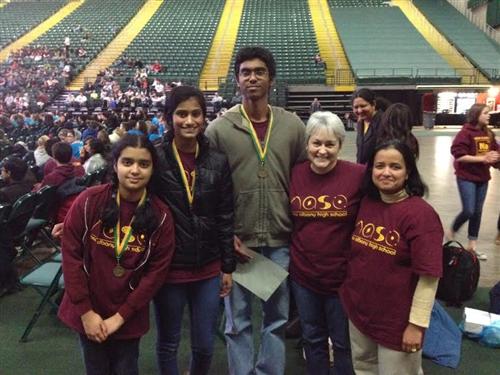
Our Science Olympiad Team continues to be a shining light for the New Albany Community! They recently competed in the Science Olympiad state competition and brought home the 6th place trophy! Coach Sudha Ganesan says, “The long hours your students put in studying/building/practicing for their events certainly paid off.”

Science Olympiad L. Love story

Congratulations to the following students on their outstanding Science Olympiad performance:
Shankar Pattabhiraman (1st- – Experimental Design, 2nd – Cell Biology, 5th – Protein Modeling, 6th – Anatomy and Physiology)
Bhagee Ganesan (1st – Experimental Design, 2nd – Cell Biology, 6th – Anatomy and Physiology)
Nikhil Pramod (5th – Chemistry Lab, 5th – Protein Modeling)
Nishant Chittari ( 2nd place – Wright Stuff, 7th place – Air Trajectory, 7th place – Wind Power)
Gunnar Wielinski (2nd place – Wright Stuff, 7th place – Air Trajectory, 9th place – Bridge Building)
Aditya Mistry (5th place – Protein Modeling, 7th place – Wind Power)
Jovitha Nelson (1st place – Experimental Design)
David Tan (5th place – Chemistry Lab)
Olivia Samson (10th place – Fossils)
Wilson Wu (10th place – Fossils)

Our sophomore and juniors had the unique opportunity to engage in a conversation with three-time cancer survivor and CEO of Pelotonia Mr. Doug Ulman! Mr. Ulman was the guest at the annual Wexner Leadership Series event, which is organized by Mr. and Mrs. Tuckermann and features Mr. Les Wexner.
Screenshot 2016-04-24 16.25.30

Upcoming Events
• Monday, April 25th- 4th quarter Interim Project Reports; Board of Education Meeting at 6:30 pm in The Jefferson Room
• Wednesday, April 27th- Administrative Assistant Appreciation Day; Staff Meeting
• Friday, April 29th- Staff Meeting Senior Environmental Science Research Presentations; MacBeth at 7:00 PM at the Mershad
• Saturday, April 30th- MacBeth at 7:00 pm at the Mershad
• Sunday, May 1st- MacBeth at 2:00 pm at The Mershad

Articles Worth Reading
How Moxie Can Help Students Succeed
Greater Competition for College Places Means Higher Anxiety, Too
9 Ways to Upgrade Professional Learning in Your District

Be Great,

Dwight